 Dungeon Merlin
Sorry to go all middle-aged basketball coach on you here, but if you’re the type of person who takes playing their elfgames seriously enough to read blog posts about how to be a better player, I’m about 85% certain that you’re procrastinating right now.
Don’t get me wrong: that’s fine in my book. I procrastinate almost all of the time and I generally can’t complain. So who am I to judge? But as we both know, procrastinating is not how you actually improve. Otherwise, I would be a Vermeer-level painter by now, having procrastinated learning to paint for literal decades. So if actual improvement is the goal, the procrastination has to go. That means reading less and doing more. Well… less, actually, but we’ll get there.
What I mean when I say you’re probably procrastinating is that you likely already know what you’d like to be better at more specifically than “I’d like to be a better player”. People who want to improve either have a sense for what they’d like to improve at, or will have already watched or1 read a ton of stuff giving them an idea of what might be valuable paths to explore. Possessing that knowledge is already enough for you to take the next step on your quest for total player bliss.
Maybe it’s that you always freeze up when there’s role-played dialogue and don’t know what to say or how to say it. Maybe it’s that you want to focus more but it seems impossible to keep your attention up the whole time. Or it might just be that you don’t like something about how your group plays and you’d like to get better at articulating that.2
Whatever it is, the beautiful thing about RPGs is that if you have a group that meets regularly, you already have the perfect structure to improve at it. You’ll just have to start treating your sessions as training in addition to3 opportunities to shoot the shit with your friends.
For some reason, taking RPGs seriously as a hobby you’d like to get better at this way feels weird to many of us. But why? It’s not like we have the same reservations about other things we voluntarily spend our time on, like martial arts, knitting, writing, drawing, etc. It’s so normal to approach learning all of these in a somewhat structured manner that we sometimes don’t even notice we’re doing it. But more often than not with these, we’re taking small, incremental steps on our way towards holistic mastery.45
You’ll also need a bit of patience, as this is probably going to take longer than you’d like. But there is a simple algorithm that, when followed, basically guarantees you’ll get better over time. Let’s call it the Loop of Improvement™️, because why not. It works like this:
- Take stock
- Pick one thing
- Identify the next step
- Take that step
- Review
- Either take step again, or pick new thing
Here’s what these steps mean in more detail:
1. Take Stock
Write down everything you feel could be improved about your own play, game, group, etc. Trust your gut here. I would be very surprised if nothing comes to mind. But if that’s the case, what are you even doing here? Get out while you still can and go have actual fun. Don’t let me—a blogger—convince you you’re not enough!
Alternatively, read up on some general player advice to get an overview of what’s possible. There’s a lot of good stuff out there. Maybe start with the Player tag over on Patchwork Paladin, or these recent posts by Sam. Or literally any other post from the Player Advice Blogwagon this post is part of. Every single one I read was worth it in some way so far.
2. Pick one thing
Of the things you wrote down, pick a single one that tickles you the most. This will be the one you’ll focus on for now.
For me, recently, that was my ability to improvise dialogue.
3. Identify the next step
Read up on the specific thing you chose until you have an idea of a single step you could take to improve at it. Most likely, a single video or blog post will be enough here. Sometimes it takes more to find something that clicks with how your brain works. The important part is to keep your search narrow, and stop once you’vi identified that single next step for you.
When dealing with my improvised dialogue example, I knew what I was looking for was content about improv (d’uh) and ultimately decided I would try to follow two pieces of advice from a document shared by Ty in which he collected his wisdom on how to do improv. Namely “be obvious and average” and “go line for line”. The document contains a lot more advice, but I thought that these two pieces would be more than enough to keep me occupied for a few sessions. Even one would’ve probably been enough, but I felt that they went well together. So I scribbled both of them onto my session notes sheet and that was it for preparation.
4. Try taking that step in your next session
In your next session, make it one of your priorities to consciously implement the advice you identified in step three. Don’t make it your only priority; that should still be having fun with your group (or whatever it is you people are aiming for—I’m looking at you larpers out there). But try to remind yourself of your chosen step throughout, and take it as often as makes sense.
Returning to my example, I tried to consciously suppress my natural instinct to try hard to be clever or funny or both during my next session (be obvious and average), and spoke a lot less each turn, but a lot more overall (go line for line).
5. Review what went well and what could still go better
After the session, take stock. Think about how it felt to implement the change. Did it feel good? Better? Different? Maybe even worse? If it’s the latter, be aware that this might be temporary while you adjust to your new normal. If it felt good, think about whether you’re completely happy with how it went, or if you still have the feeling that there’s more juice to be squeezed here.
When I changed how I approached dialogue, the improvement was immediately obvious. For the first time, it was an aspect of our sessions I actually enjoyed. But I also knew that it wasn’t automatic yet. I still had to consciously remind myself of Ty’s advice every time I opened my mouth.
6. Either take step again, or pick new thing
If you’re fully confident in your ability to repeat what you did, you’re ready to go back to step two and pick another thing from your list. If your list is empty, go back to step one.
If you’re not completely happy yet, go back to step four and simply repeat what you did next session to hammer it home, or go back to step three to find a step that fits you better.
I was very happy with the results from my experiments, but since it still was anything but automatic, I decided to simply keep repeating it until it became more natural. Every time since, it has gotten easier, and I think I’ll be ready to pick something new to improve about my play soon.
Conclusion
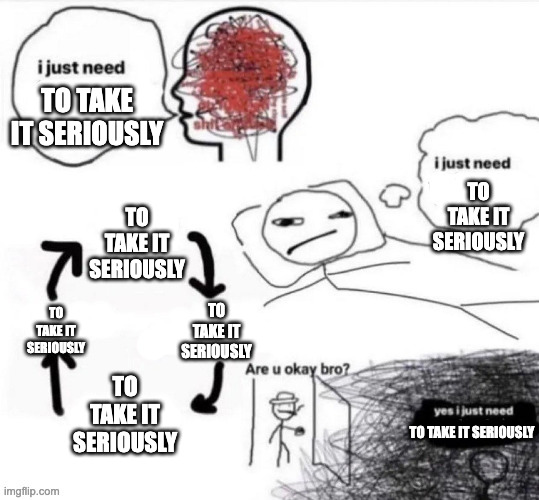
The important parts here are focus, scope, and actually doing the thing, over and over again. Zoom in on a very concrete thing and forget about everything else. This keeps it manageable and stops it from taking over your whole session. Over time, these small steps will compound. Trust the process. Trust the Loop of Improvement™️.
And the best thing? This also works, almost verbatim, for GMs and even general life stuff.
P.S.: Yes, I’m fully aware that this whole post has just been a wordy restatement of the Kaizen principle. Go figure.
Footnotes
-
More likely: and ↩
-
Please be aware that if everyone is having fun, there’s no real need for you to get better at any of this. Not everything you do has to be this sweaty. But you clicked on this article, so I’m taking it as given that you’re a fellow sweaty person. ↩
-
But not instead of. That part’s important! ↩
-
Notice that I’m explicitly not talking about doing something for competition. This is about the joy of being good at something, not better at it than others. ↩
-
One of my white whale projects is an RPG that teaches itself to you in a structured way like video games do, disclosing more and more of its systems over time, instead of the truly insane kitchen-sink approach literally every RPG out there chose. ↩